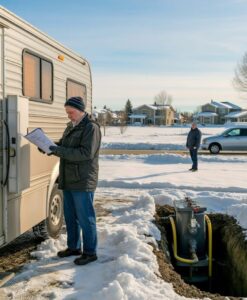
The cold that woke me that January morning was not the gradual kind. It was not the slow chill of a furnace cycling down overnight or a window left cracked. It kicked the door in. One moment I was asleep, the next I was sitting upright in the dark with forty-two degrees registering on the trailer thermometer and the particular silence that replaces the hum of a working heater. I pulled on my boots and my coat and stepped outside, and my breath turned to steam and I looked at my electric meter and saw the tag. Big and red, zip-tied to the conduit with the efficiency of someone who had done this before and expected no argument. Violation of winter aesthetic compliance. Fine: nine hundred dollars. Remove non-conforming dwelling within fourteen days.
Wind chill at negative eighteen. The meter pulled. The tag flapping in the dark like something that found the situation amusing.
My name is Cole Mercer. I am thirty-six years old, a licensed electrician, and the third generation of my family to own a forty-three acre parcel of scrub pine and frozen high-country dirt just outside Bozeman. My grandfather, Ray Mercer, bought the land in 1959 when it was sagebrush and sky and nothing else for a quarter mile in any direction. My father grew up on it. I grew up on it. I am currently building a house on it the slow way, which means cash, which means wiring it myself, which means I live in a fifth-wheel trailer parked on my own property while the house goes up room by room at the pace my bank account allows. This arrangement is not glamorous. It is also nobody else’s business.
Ezoic
The subdivision that now surrounds three sides of my property was not there when my grandfather ran cattle on this ground. The stone monument sign at the gated entrance, the architectural review committee, the heated driveways and the three-car garages and the windows glowing like magazine covers every winter night, all of that came later, most of it within the past decade. The HOA had expanded its boundary influence a few years back through what my attorney would later describe as some creative legal gymnastics, annexing adjacent parcels and bringing them under community oversight. That was their phrase. Community oversight. My grandfather’s parcel came along for the ride whether we wanted it to or not, which we did not, and which no one had asked us about.
Diane Whitaker had been the HOA president for six years. Late fifties, composed in the specific way of someone who has confused the calm of authority with the authority itself, pearl white Range Rover, the kind of smile that suggests she is doing you a favor by speaking to you. Her favorite phrase was community harmony. She used it the way certain people use the word unfortunately, as a cushion placed under something hard before it lands on you. I had received three violation notices in the two years since the annexation. Trailer visibility from the road. Trailer dimensions exceeding temporary structure guidelines. And now, on the coldest morning of the year, trailer presence constituting disruption to the seasonal uniformity of the neighborhood.
Ezoic
Seasonal uniformity. In a blizzard. With a wind chill that was already working on my pipes.
By nine in the morning, two of them had burst. I was at the hardware store by ten, hauling space heaters back to the trailer, trying to keep the interior temperature above the point at which the remaining lines would go. The burst pipes cost me twenty-four hundred dollars in damage before noon, and I spent that afternoon with my boots wet and my hands numb, running heat to a space that should have had electricity if the woman who answered the phone on the second ring and called me Cole in the tone of someone explaining a parking ticket had not decided that my trailer disrupted the neighborhood’s aesthetic relationship with winter.
I called the number. Diane told me the community had received multiple complaints. She told me the trailer disrupted the seasonal uniformity of the neighborhood. She said it with the mild regret of a person delivering inconvenient but necessary information, and I understood that she had rehearsed the conversation before I called and was moving through her prepared version of it. I told her that my pipes had burst. She expressed that she was sorry to hear that and suggested I contact a plumber. We were not, it was clear, having the same conversation.
Ezoic
Two days later, working in my shop on a night when I had nothing better to do than be angry in a productive direction, I went through a box of old property documents I had moved three times without opening. They had belonged to my grandfather and then to my father and they smelled of the particular combination of dust and age that belongs to paper that has been sitting in the same place for decades. Most of it was routine: deed transfers, tax records, survey maps. Then I found a yellowed folder at the bottom, labeled in my grandfather’s handwriting: utility easement, 1962.
Inside was a survey map I did not recognize and a handwritten note in Ray Mercer’s careful block print. The note explained that in the early 1960s, before the city extended natural gas service out this far, he had paid to have a private pipeline installed from the main junction two miles east. Two point seven miles of buried steel running from that junction through what was now, sixty years later, the entire subdivision. The pipeline branched to forty-seven connections. Forty-seven houses. Every furnace in that subdivision, the heated floors and the warm garages and the glowing windows, ran on a line that my grandfather had put in the ground and paid for out of his own pocket.
The note at the bottom read, in the looping script he used when he was writing something informal: for neighbors. No charge.
Ezoic
No contract. No conveyance. No utility company takeover. No formal easement dedication to the municipality. Just a man with good intentions and a shovel crew and the particular generosity of someone who did not yet understand that goodwill without documentation creates problems that outlast the goodwill by decades.
I called my attorney, an old classmate named Paul who reads statutes the way other people read novels and who had helped me with the annexation dispute two years earlier. I sent him the folder. He called me back three days later. His voice had the quality of someone trying to contain what they are feeling long enough to get through the sentence.
Cole, he said. The pipeline is still deeded under your parcel. There has been no municipal adoption. There is no HOA utility agreement on record. Legally it is yours. Including the master shutoff valve. He paused. The valve is in a concrete vault on your property, near the old well cap on the northeast corner.
Ezoic
I did not sleep well that night. Not because I had already decided what to do but because I understood, for the first time, the full shape of the situation I was standing in. This was no longer about a trailer or a nine-hundred-dollar fine or the question of whether my fifth-wheel disrupted anyone’s experience of winter. This was about the fact that my family’s land, and a piece of infrastructure my grandfather had installed out of neighborly goodwill, had been absorbed into someone else’s idea of order without anyone ever asking permission or establishing terms. And the same authority that had attached a red tag to my meter in a January blizzard was operating under the assumption that everything within its declared boundary was subject to its control, including things it had never owned.
The next morning I walked out to the concrete vault near the old well cap. Snow had drifted over it, smoothed it into a gentle mound that looked like nothing in particular. I swept it clear with my boot, pried up the lid, and looked at what was inside. The valve was old, cast iron, surface rust on the handle but solid under it, the kind of industrial hardware built in an era when things were made to outlast their builders. It fed every furnace in forty-seven houses. I had the documentation to prove it was mine. I had a nine-hundred-dollar fine on my table and twenty-four hundred in pipe damage and three years of violation notices before that, all of them issued by an organization that had decided my presence was an aesthetic problem worth correcting at any cost, including utility termination in sub-zero weather.
I stood at that vault for a long time.
I want to be honest about what I felt standing there, because this is the part of the story where it would be easy to simplify things. I was angry, obviously. I had been angry for three years and more acutely for the past forty-eight hours. But anger by itself does not make you reach for a valve. What made me reach for it was something more considered than anger. It was the recognition that the only language the situation had responded to so far was force, and that the only leverage I had was the one I was looking at. Not to hurt anyone. Not to make a point through suffering. But to stop being treated as disposable on land my grandfather had cleared by hand, and to make the terms of what was actually mine visible to people who had been operating as though those terms did not exist.
Ezoic
I turned the valve ninety degrees. Slow, deliberate. The handle moved with the resistance of something that had not been touched in years, then gave. I closed the lid, walked back to the trailer, and made coffee.
Within thirty minutes my phone was going. Text from a neighbor two lots over: gas pressure issue, anyone else? Another: something wrong with my furnace. Then Diane, her voice carrying a tightness that had not been in it two days ago. Cole, we are experiencing a service interruption in the community. Is your gas line running normally?
Interesting, I said. According to my records, that is a private line.
The silence that followed had a specific quality. It was the silence of someone recalculating.
I spent the afternoon drafting certified letters, forty-seven of them, one for each household on the pipeline. The terms were clear and I had Paul review them before I sent anything. Gas service would resume upon execution of a formal utility lease: three hundred and eighty dollars per household per month, October through March, fifteen-year term. Reimbursement for the twenty-four hundred in damages caused by the wrongful power termination. Immediate removal of all trailer restrictions and outstanding fines. Written acknowledgement that my land use was not subject to HOA aesthetic oversight. No signature, no heat. I sent the letters by certified mail and followed up with electronic copies because Paul believed in redundancy.
Ezoic
Was this aggressive? Yes. So is pulling someone’s power meter in a blizzard over curb appeal.
By nightfall the temperature had dropped to negative ten and the neighborhood’s social media group was generating the kind of activity it usually reserved for disputes about fence heights and holiday decoration schedules. Families scrambling for propane heaters. People booking hotel rooms. Tailights rolling out of driveways like a slow, cold evacuation. Someone posted asking whether it was possible for the community to override my valve, and I read that word, override, with the particular interest of someone who had recently learned that override does not apply to infrastructure you do not own.
Diane called again around nine in the evening. This is reckless, she said. Her voice was tighter now, the composure working harder to hold its shape. I told her, calmly, staring at the thermometer in my trailer climbing back toward seventy because I had hooked into my backup generator two days ago when the meter was pulled, that reckless was cutting power to a residential structure in a winter storm over an aesthetic complaint. She threatened legal action. I told her I had paperwork older than her Range Rover and suggested she have her attorney pull the county utility filings before anyone filed anything.
The following morning it was negative twelve. The kind of cold that makes the air brittle, that settles into a landscape and makes every structure look temporary. I made coffee deliberately and let it drip and did not rush, because one of the things I understood about leverage was that using it well required patience. At around eight, a knock at my trailer door: Trevor, the software engineer two houses down who jogged past my property three times a week without acknowledging I existed. He was wearing a parka over pajama pants, his breath coming hard in the cold air.
Ezoic
He said he wanted to ask about the gas thing. He was trying to sound casual, as though he had wandered over out of curiosity rather than necessity, and I let him have the effort. I told him it was a private infrastructure dispute. I watched his face move through confusion into calculation, and I recognized the moment when he stopped thinking about what had happened and started thinking about what it would cost him. That was a reasonable thing to think about. I did not blame him for it.
By early afternoon, a fire truck was in the subdivision, sirens off but lights rolling slowly. An elderly couple on the north end had tried to run a propane heater in their living room with the windows closed. Carbon monoxide detector had gone off. The fire department did a welfare check, which turned into something more consequential when the fire captain asked who maintained the gas infrastructure and Diane, standing in the cold with the captain and two other officials, told him the community did. He asked for utility permits. She did not have them. He asked who owned the line. The silence that followed was not the practiced kind. It was the silence of someone who has just understood that a question they cannot answer is also a question someone else can.
You cannot bluff paperwork when someone with a badge is holding a clipboard. What happened in the HOA’s emergency meeting that evening I know mostly from a partial livestream that one of the residents posted before someone in the room asked them to stop: folding chairs in an unheated room, raised voices, a board member standing up and asking how forty-seven homes could be dependent on infrastructure the HOA had never actually owned. Another board member resigned while the livestream was still running. Then a third. Diane kept using the phrase temporary service disruption, repeating it with diminishing effect until it became clear that saying something enough times does not make it true when the room is cold and the people in it are holding certified letters explaining why.
Ezoic
At seven-thirty that evening, Diane called again. The composure was gone. What are your terms, she asked. Not angry, not polished. Just tight, functional, the voice of someone doing the math on liability exposure and not liking the numbers.
Same as the letters, I said. Plus one amendment. She waited. You step down as president. The bylaws get rewritten to clarify infrastructure ownership and establish a formal process for any future utility oversight claims.
She called it extortion. I told her it was formalization. She said I was punishing families. I looked at the warped cabinet door from the burst pipe, at the invoice sitting on my table, at three years of violation notices in a folder I had started keeping specifically because I had understood early that documentation was going to matter eventually. They punished me first, I said. I do not take credit for that sentence. It was simply what was true.
Ezoic
There was a long pause on the line. Long enough that I could hear wind moving outside her window and the particular silence of a heated house that has not been heated for two days. Then she exhaled. She did not say anything else. She hung up.
At nine o’clock, the revised contract went out electronically. Paul had spent the afternoon tightening the language: clear lease terms, indemnification clauses, annual inspection rights, maintenance cost-sharing going forward. Not revenge. Structure. The kind of structure my grandfather’s original goodwill had never had, the kind that makes a thing durable instead of just good-natured. Forty-seven households. Deadline eleven fifty-nine.
Outside it was negative fifteen. Inside the trailer the generator ran steady, the thermometer holding at seventy-one, the specific warmth of a space where everything is working correctly.