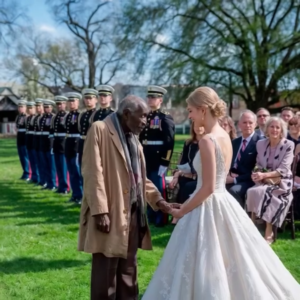
After his passing, ownership of the property fell to his younger brother!

The backyard of Lester Vance’s dilapidated country estate had always been presided over by a singular, brooding presence: an ancient oak tree that stood like a sentinel guarding a secret it had no intention of yielding. To the local children, it was a source of whispered ghost stories; to the adults, it was a nuisance of tangled roots and falling debris. But to Lester, the tree was sacred. He had protected it with a ferocity that bordered on the obsessive, growling at neighbors and even his own brother, Silas, if they stepped too close to its gnarled trunk.

When Lester passed away in February 2026, the tree was not mourned. It stood motionless under a bleak Montana sky, its skeletal branches reaching out like grasping fingers. Silas Vance, having not spoken to his brother in over two years, stood at the funeral with his hat in his hand, feeling the hollow ache of a bond eroded by time and silence. Lester had returned from Vietnam a “calmer, darker” man, his once-vibrant personality replaced by a stoic shell and a penchant for isolation. He left behind no wife, no children, and no explanations—only a crumbling house and the deed to a property he had treated like a fortress.

A week after the funeral, Silas drove up the winding dirt path to the estate. The house was a relic of neglect; the green paint was flaking off in long, jaundiced strips, and the porch moaned under his weight. But it was the tree that dominated the view. It was larger than Silas remembered, its roots aggressively heaving up the brick walkway as if trying to reclaim the earth from the house itself.

He recalled a childhood spent in the shadow of his brother’s temper. Even as an adult, the mere mention of pruning the oak would send Lester into a spiraling rage. “Leave it alone,” Lester had once snarled, his eyes unfocused, staring at the bark. “You have no idea what’s keeping it together.” At the time, Silas had dismissed the outburst as the poetic rambling of a veteran struggling with his mental health. Standing there now, in the oppressive silence of the backyard, he wasn’t so sure.

Silas had no intention of living in the shadow of his brother’s ghosts. His plan was pragmatic: renovate the house, clear the overgrown lot, and sell the property to the highest bidder. To do that, the tree had to go. It was an eyesore that threatened the foundation of the house, a magnificent but dangerous giant.

The logging crew arrived two days later with the mechanical roar of chainsaws and the heavy scent of diesel. It took less than an hour to bring the sentinel down. When the oak finally gave way, it hit the ground with a thundering crack that seemed to vibrate through Silas’s very bones. As the dust settled and the birds that had nested in its canopy fled into the pines, the loggers noticed the first peculiarity.

“Base is hollow,” one of the workmen noted, wiping sweat from his brow. He pointed to the exposed root system where the earth seemed strangely disturbed. “Looks like someone did some digging here a long time ago.” The crew shrugged, collected their gear, and left, leaving Silas alone with the stump and a growing sense of unease.

The following morning, a gnawing curiosity—the kind that keeps a man awake in the small hours—drove Silas back to the yard. He took a shovel from the shed and began to dig into the soft, dark earth at the center of the hollow stump. He dug until his shirt was plastered to his back and the sun began to dip behind the jagged mountain peaks. He was on the verge of quitting, convinced he was chasing a phantom, when the blade of his shovel struck something hard and metallic.

With trembling hands, Silas cleared away the dirt to reveal a heavy, oxidized steel footlocker. It was a military-issue chest, the kind used by soldiers in the 1960s. The lock had long ago rusted away, requiring only a firm pry from the shovel to snap. As the lid creaked open, Silas didn’t find the gold or buried treasure he had half-expected. Instead, he found the weight of a brother’s soul.

Inside the locker were bundles of letters, never mailed, addressed to Silas. They were dated from 1968 to 1970, written on thin, yellowed paper. As Silas read the first few, the image of the “dark, silent” Lester began to dissolve. The letters described a man who was terrified, not of the war, but of the person he was becoming. They spoke of a traumatic event—a decision made in the heat of a jungle skirmish that had cost lives—and the crushing guilt that Lester had carried home.

But beneath the letters was something even more significant. Wrapped in a faded American flag was a collection of personal effects: dog tags that didn’t belong to Lester, a series of photographs of a Vietnamese family, and a small, hand-carved wooden bird. Lester hadn’t been protecting a tree; he had been standing guard over a makeshift memorial. The tree was the only thing “keeping him together” because it served as a living tombstone for the parts of himself he had buried in the mud of a distant land.

Discover more
Cameras
True crime stories
Christmas party supplies
The discovery placed Silas in the middle of a narrative that was playing out across the country in 2026. As the world dealt with the fallout of modern conflicts and the “Prophet of Doom” shared dire predictions, Silas was confronted with a very old, very personal tragedy. He realized that Lester’s isolation wasn’t a rejection of his brother, but an act of penance. Lester had lived his entire life in the backyard of his own trauma, afraid that if the tree fell, the truth would crush them both.

Silas sat on the stump of the oak, the unmailed letters scattered around him like fallen leaves. The renovation of the house no longer felt like a chore; it felt like a responsibility. He decided then that he wouldn’t sell the property. Instead, he would restore the garden and plant a new grove of trees—not as sentinels of secrets, but as a place of transparency and healing.

He took the military chest inside and placed it on the mantle. Lester was gone, but for the first time in decades, Silas felt like he actually knew his brother. The tree had been removed, but the silence it left behind was finally filled with words.


Related Posts

When I was 16, our house caught on fire at night.

When I was 16, our house caught on fire at night. My dad pulled me out through the front door. He went to get my mom and…

Woman Screams When She Spots ‘Two-Headed Snake’ In Back Garden, Stunned When She Realizes What It Really Is

In March 2017, a viral video captured worldwide attention with a bizarre creature spotted in Santa Fe, Argentina. A woman named Lujan Eroles discovered what appeared to…

They watched me fall, convinced my $2 billion empire would die with me! They say a mother knows her child best, but in the heart of the Amazon, maternal instinct is drowned out by the primal roar of a jungle that does not care for sentiment. My name is Eleanor Thorne. I am seventy-two years old, and my net worth sits comfortably north of two billion dollars. I spent five decades breaking glass ceilings, constructing a logistics empire from a solitary warehouse in Chicago into a global titan that moves the world’s commerce. I learned to silence boardrooms with a single look, to predict market crashes before the first ticker tape fell, and to smell fear in a negotiation from across a mahogany table. Yet, for all my acumen, for all my hard-won wisdom, I failed to spot the predators sleeping in the bedrooms down the hall of my own home. The trip was Richard’s idea. My husband of forty years, a man whose charm had aged into a polished, expensive veneer, insisted we needed a “digital detox.” He called it a bonding experience—just us and our son, Julian. He spoke of the Amazon as something primitive and raw, a chance to reconnect before I inevitably had to “slow down.” That phrase had become a recurring motif in their vocabulary lately—a polite euphemism for death or retirement, whichever claimed me first. They looked at my gray hair and saw a fading light; I looked in the mirror and saw tempered steel. I agreed to the excursion, mostly to silence the nagging voice in my head that whispered my family looked at me and saw only a walking bank vault. I wanted to believe that Julian, my forty-year-old son whom I had coddled and shielded from the world’s sharp edges, actually craved his mother’s company. I wanted to believe Richard still saw the woman he married, not just the portfolio he managed. But as our private charter boat cut through the dark, silken waters of the Rio Negro, the air felt heavy with the weight of unsaid things. The humidity was a physical presence, pressing against my chest. The jungle on either side was a wall of green, screaming with the sounds of things fighting to survive. Julian sat at the bow, scrolling on a satellite phone he wasn’t supposed to have, sweating through his designer linen. When he caught me looking, he forced a smile—a shark flashing its teeth. I had built a fortune on paranoia, on assuming the worst in people to protect the best of my interests. Why had I turned that instinct off for my own flesh and blood? Discover more Cameras Movies family The guide, a local man named Mateo, cut the engine as we drifted into a stagnant oxbow lake, the water black as oil. He pointed to the banks, whispering of caimans—ancient, hungry, and patient. Richard stood up, balancing carefully on the swaying deck, and moved toward me. His cologne, a heavy musk, clashed violently with the scent of river mud and decay. He whispered a strange, nonsensical question into my ear: “Are we going down with the crocodiles, Eleanor?” Confusion knitted my brow, but before I could process the threat, I saw Julian move. The push didn’t feel like a push; it felt like a total betrayal of the laws of physics and nature. Two pairs of hands—one I had held at the altar, the other I had held when it was tiny and helpless—shoved against my back with synchronized force. Gravity is unforgiving to seventy-two-year-old bones. I staggered, my boots slipping on the wet deck, and flailed at the humid air before the world turned upside down. I hit the water with a bone-jarring smack. The shock was immediate—a suffocating, cold embrace that sucked the air from my lungs. I went under, the darkness swallowing me whole. Panic, sharp and primal, spiked in my chest. They had done it. I kicked wildly, my heavy clothes dragging me toward the silt. I fought the urge to inhale the river, forcing my eyes open in the murk. I broke the surface, coughing up water that tasted of iron, and looked toward the boat. It was already accelerating. Julian stood at the stern, gripping the railing, his knuckles white with a look of twisted, sick satisfaction. He thought the two billion dollars were finally his. Richard wasn’t even looking back; he was facing forward, toward a future he thought he had just purchased with my life. Terror is a powerful fuel. It burned through the exhaustion in my limbs. I wasn’t going to die as fish food in a forgotten swamp. I thrashed toward the tangled roots of the mangroves, pulling myself onto a muddy bank that smelled of rot. I collapsed there, shivering, my silver hair plastered to my face, watching the boat disappear around the bend. They had left me for dead, but they had made a fatal error: they hadn’t checked for a pulse. They assumed the river would do their dirty work. Discover more Cameras Movies family Getting back was a blur of misery. I traded my platinum diamond ring—a fortieth-anniversary gift from my would-be murderer—for a ride in a dilapidated truck to Manaus. From there, I accessed an emergency offshore account I kept for kidnappings, a precaution I never thought I’d use against my own family. I chartered a private jet to a small airstrip in Connecticut, avoiding our usual hangars to ensure I remained a ghost. According to the news, the search for my body had been called off. Julian had given a tearful press conference, playing the part of the grieving son with disgusting precision. I didn’t go home. I went to a safe house in Manhattan and summoned my personal attorney, Arthur Vance. I spent twenty-four hours “dead,” using that time to dismantle the lives of the men who tried to end mine. What I found wasn’t just greed; it was staggering incompetence. Julian had been embezzling for years to cover gambling debts and failed venture capital projects. Richard had been liquidating assets to fund a getaway with a mistress in Monaco. I wasn’t pushed because I was loved; I was pushed because I was the dam holding back the flood of their own failures. I organized every incriminating document into a leather binder. The following evening, I entered our estate through the service entrance. I stood in the shadows of the library as Richard and Julian toasted to their new “freedom” with my finest scotch. When I stepped into the light, the color drained from their faces so fast it was as if I had pulled a plug. Julian dropped his glass, the crystal shattering on the marble floor. “You look as though you’ve seen a ghost,” I said, my voice as cold as the Rio Negro. Richard tried to stammer an explanation, but I laid the binder on the table. I told them exactly what was going to happen. I wasn’t calling the police—not yet. I was going to strip them of everything. The trust funds, the properties, the names, the dignity. I was initiating a hostile takeover of my family. I gave them one hour to pack a single suitcase each before the security team I had hired escorted them to the gate. They watched me fall, convinced my empire would die with me. They forgot that I didn’t build a two-billion-dollar legacy by being a victim. I built it by being the person who survives the crash. As they were led away into the night, penniless and broken, I sat in my chair and poured myself a drink. The Amazon had tried to swallow me, but all it did was wash away the last of my illusions. I am Eleanor Thorne, and my empire has never been stronger. Interesting For You

They watched me fall, convinced my $2 billion empire would die with me! They say a mother knows her child best, but in the heart of the…

Blood-Stained Gloves Found Near Nancy Guthrie’s Home in Tucson Desert

The search for Nancy Guthrie, the 84-year-old mother of NBC’s Savannah Guthrie, took a chilling new turn last week when a local couple in Tucson stumbled across…

What Really Happened With the Deleted Scene From Jaws

Steven Spielberg’s Jaws is widely regarded as a masterpiece of suspense, but one chilling moment was intentionally left off the screen. The 1975 blockbuster, which launched Spielberg’s…

Eight Dead After Devastating Avalanche in the Sierra Nevada

A guided backcountry ski trip in the Sierra Nevada turned tragic on February 17, 2026, when an avalanche struck near Castle Peak outside Truckee, California. The slide…

Leave a Reply

Your email address will not be published. Required fields are marked *