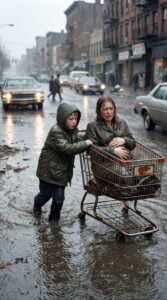
The storm had transformed Cleveland’s streets into rushing channels of water. Rain slammed against the pavement, bouncing back in sheets, gathering beneath an overpass where cars funneled through without slowing.
Headlights sliced through the darkness, spraying water onto the sidewalks, never pausing long enough to care.
In the center of the flooded road sat a woman.
She was heavily pregnant, drenched and trembling, struggling just to remain upright. Her phone lay submerged beside her, useless. One shoe was missing. Each attempt to stand ended the same way—pain contorting her face before she collapsed again, breathless.
Cars slowed.
Drivers looked.
Then they kept going.
From under the overpass, Ethan saw everything.
He was twelve—gaunt, nearly invisible, wearing a jacket too large for him, torn at the sleeve. He slept on cardboard, ate where he could, and learned early that being unseen was the safest way to survive. Rain soaked through his clothes, and hunger gnawed relentlessly at his gut.
He should have stayed put.
Kids like him didn’t intervene.
Kids like him didn’t matter.
Then the woman lifted her head.
Their eyes met.
Fear recognizes fear.
“Help…” she whispered, the rain nearly erasing the word.
Ethan’s heart pounded. He didn’t know her—and it didn’t matter. Something inside him shifted anyway.
He stepped into the storm.
“Ma’am?” he called, his voice quiet but steady. “Can you hear me?”
She looked at him, disbelief breaking whatever control she had left.
“I can’t stand,” she said, tears blending with rain. “I tried. I really did.”
Another wave of pain doubled her over.
Ethan didn’t hesitate.
“There’s a wheelbarrow under the bridge,” he said. “I can push you.”
She stared at him, horrified.
“You’re just a child.”
“I’ll be okay,” he answered. “You won’t.”
The metal handles were icy and slick, far heavier than he expected. His arms burned. Water filled his shoes. A horn blared. Someone shouted something cruel.
Ethan kept moving.
“You’re alright,” he murmured again and again. “I’ve got you. I won’t let you fall.”
By the time red lights pierced the storm, his arms were shaking uncontrollably. Paramedics rushed in, voices calm but urgent, lifting the woman onto a stretcher.
One of them turned to Ethan.
“Did you bring her here?”
Ethan nodded.
“You did the right thing,” the man said firmly. “You may have saved two lives tonight.”
Ethan didn’t stay to hear more.
He stepped back into the rain and vanished.
Three days later, the storm felt unreal—like something that had happened to someone else.
Ethan sat on the cold pavement outside a soup kitchen, picking at stale bread. His body ached in unfamiliar ways. The memory of the woman’s face lingered—especially the way she had clung to hope.
He hadn’t told anyone.
Why would he?
Good deeds didn’t change anything for kids like him. Help didn’t come back around.