The Test That Ended a Family
The nursery walls were painted a soft, hopeful yellow. A white crib stood beneath the window—the same crib Emma and I had assembled together three months before our son arrived. I remembered how she’d laughed while I fumbled with the instructions, how she eventually took over, finishing it effortlessly while I handed her screws and pretended not to sulk. I had thought that was happiness.
Now I stood in that room, our two-week-old baby sleeping quietly in the crib, and felt a cold clarity settle over me. Every certainty I’d built my life on suddenly felt false
“Marcus?” Emma’s voice came from the doorway. She sounded exhausted, confused. “What’s going on? You’ve been distant all week.”
I turned to face her. The paternity test kit felt heavy in my hands—like both armor and ammunition. She wore the oversized sweater she’d lived in since giving birth, hair tied back without care, dark shadows beneath her eyes from endless nights awake. She looked fragile. Real. Unprepared for what I was about to do.
“I need you to take this,” I said, extending the box.
She didn’t move. Just stared at it, as if it didn’t belong in her world.
“What is that?”
“A paternity test.” My voice was flat. “I need to know if the baby is mine.”
The silence that followed was suffocating. I could hear the hallway clock ticking. Our son’s soft breaths. My pulse roaring in my ears. Emma’s expression shifted—confusion giving way to pain, then disbelief, and finally something I couldn’t name. Something like acceptance.
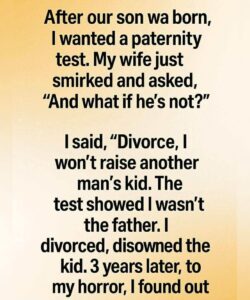
“And if he isn’t yours?” she asked quietly.
That question landed like a confession. My chest tightened.
“Then I file for divorce,” I said harshly. “I won’t raise another man’s child.”
She nodded slowly. “Alright. If that’s what you need.”
She took the kit from my hand and walked out of the nursery, leaving me alone with a sleeping infant and a sense of victory that felt strangely empty.
The Envelope
Five days. That’s how long it took for the results to arrive. Five days of living like strangers in the same house. Emma cared for our baby with robotic efficiency, speaking only when necessary. I told myself her silence meant guilt. That she was preparing for exposure. That I’d been right.
When the envelope finally arrived, I opened it alone in my car, parked in our driveway. My hands shook as I unfolded the paper.
Probability of Paternity: 0%.
Marcus Jerome Patterson is excluded as the biological father.
Zero.
Not mine.
I sat there staring at the words, feeling vindicated and destroyed at the same time. I had been right—and it felt unbearable. Everything we’d built collapsed into meaninglessness. The child I’d prepared to love wasn’t mine. The marriage was a lie.
Inside, Emma was making lunch. The baby slept nearby. She looked at me and knew.
“The results came,” I said.
She swallowed. “And?”
“Zero percent. He’s not my son.”
She closed her eyes. “Marcus—”
“I don’t want explanations,” I snapped. “I’ve already contacted a lawyer. I’ll be gone by the end of the week.”
“You won’t even listen?” Her voice cracked. “You won’t let me explain anything?”
“Explain what? That you cheated? That you lied? Nothing changes what that paper says.”
She studied me, and something hardened in her expression.
“You decided who I was long before the test,” she said quietly. “The test just gave you permission.”
I didn’t answer. Because part of me knew she was right. I’d been suspicious for months. Reading betrayal into harmless moments. But I clung to the test. Science didn’t lie.
I left three days later. Filed for divorce. Blocked her everywhere. Told friends she cheated. Anyone who questioned me got cut off.