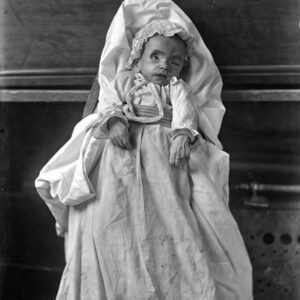
Long before Graceland, long before the name Presley echoed across the world and became synonymous with music, fame, and cultural revolution, the story began quietly in rural Mississippi. It began not with bright lights or applause, but with a woman whose life was shaped by fragility, faith, and an enduring hunger for love. Her name was Octavia Luvenia Mansell Smith, known tenderly by everyone as Doll.
Doll was remembered as a woman of soft, almost luminous beauty. Her pale skin and gentle features gave her an air of delicacy, as if she belonged more to the world of feeling than to the harsh realities of rural life. From an early age, illness followed her closely. Tuberculosis marked much of her childhood and youth, turning her into someone constantly protected, constantly watched over. Love, for Doll, was never casual. It was essential. It was survival.
As the youngest of seven children, she grew up accustomed to attention, yet that attention was often tinged with worry and pity. Beneath her lighthearted charm and warm smile lived a quiet longing: to be chosen fully, not because she was fragile, but because she was loved. That longing stayed with her into adulthood.
At twenty-seven, Doll found her sense of belonging with Robert Lee Smith, known as Bob, her younger cousin. Their union raised eyebrows, but it was grounded in understanding rather than convention. Bob was steady, resilient, and emotionally grounded, shaped by a heritage that blended Scots-Irish and Cherokee roots. Where Doll was delicate, Bob was enduring. Where she carried vulnerability, he carried strength. Together, they formed a balance that neither could have achieved alone.
Their home was modest but alive with warmth. Faith anchored their days, and music flowed naturally through their lives, not as performance, but as expression. Laughter and hardship coexisted within their walls. Together, they welcomed eight children, raising them in an environment where love was not spoken lightly, because life had taught them how quickly it could be taken away.
Among those children was a daughter named Gladys.
When Doll and Bob chose Gladys’s name, they gave her a middle name that reflected their deepest belief and greatest hope: Love. It was not decorative. It was intentional. It was a promise. A reminder that love was both protection and purpose.
Gladys grew up carrying her mother’s tenderness and her father’s endurance. Life was not kind to her. Hardship came early and often, shaping her into a woman who loved fiercely and feared loss just as deeply. She gave herself completely to those she loved, sometimes at the cost of her own peace. Love, to Gladys, was not something to ration. It was something to pour out fully, because she knew too well how fragile life could be.
That intensity would later define her relationship with her son, Elvis Presley. Their bond was profound, almost inseparable. The vulnerability, longing, and emotional depth that the world later heard in Elvis’s voice did not appear by chance. They were inherited. Passed down quietly through generations of women who loved deeply because they had learned to survive through love.
The story of Gladys Presley did not begin in fame, fortune, or legend. It began in small rooms filled with both hardship and laughter. It began with whispered prayers during uncertain nights, with music used to soothe weary hearts, and with love held tightly because nothing else was guaranteed.
That quiet inheritance traveled from Doll to Gladys, and from Gladys to Elvis. And in every song that reached for something pure, aching, and eternal, the echo of that first love can still be felt. A love born in rural Mississippi, shaped by faith and fragility, and carried through generations until it reached the world.